Wednesday, July 10, 2013

New Video Provides Guidance to our Nation’s Firefighters in Coping with Suicide

Einar Jensen being Interviewed


Self-care steps and risk reduction measures detailed in first-of-its-kind educational video

Denver, CO – The Carson J Spencer Foundation, in partnership with the National Action Alliance for Suicide Prevention, and the American Association of Suicidology, launched a new video today entitled Firefighters Coping with the Aftermath of Suicide, detailing self-care steps, peer support measures, suicide warning signs, and available resources to assist firefighters nationwide in coping with suicide.

“Fire service professionals can sometimes be overlooked when thinking about the impact of suicide. When a suicide occurs, their role often shifts from rescuer to fellow griever. This can sometimes be challenging for firefighters who may be unprepared for the intense, complicated, and lengthy trauma involved with suicide,” said Sally Spencer-Thomas, CEO and Co-Founder of the Carson J Spencer Foundation and producer of the video.

The video features real firefighters, many from South Metro Fire Station 34 of Lone Tree, CO, who describe their struggles in coping with the difficulty of a suicide call or the suicide of a fellow firefighter and how vital it is for fire safety departments to work on raising awareness of this issue among firefighters, who are trained to face traumatic events but are sometimes unprepared for the unique trauma associated with suicide.

To watch Firefighters Coping with the Aftermath of Suicide, please visit http://www.youtube.com/watch?v=Ryy7EyAiyeQ.

 “AAS is proud to be affiliated with this effort to recognize and mediate the impact of suicide on firefighters, as first-finders.  We hope this video helps the healing that must come after such a loss,” said Alan L. Berman, PhD, Executive Director of the American Association of Suicidology. 

Colorado Fallen Firefighters Foundation, Fire and Life Safety Educators of Colorado, the Beanstalk Foundation, and dozens of individual donors supported the funding of this project.

Jeff Dill, founder of Firefighter Behavioral Health Alliance, said, “What a tremendous honor to be involved with this project. It addressed the need to educate my brothers and sisters on behavioral health, especially in the area of firefighter suicide awareness and prevention and subsequently the pain that families and fire departments must deal with and coping skills they need after a loss."

The American Association of Suicidology (AAS; www.suicidology.org)is a membership organization founded in 1968 for all those involved in suicide prevention and intervention or touched by suicide. AAS leads the advancement of scientific and programmatic efforts in suicide prevention through research, education and training, the development of standards and resources, and survivor support services.
Contact: Alan L. Berman, PhD, ABPP, Executive Director, 202-237-2280, berman@suicidology.org

The Carson J Spencer Foundation (www.CarsonJSpencer.org) is a Colorado nonprofit, established in 2005. We envision a world where leaders and communities are committed to sustaining a passion for living. We sustain a passion for living by:
·         Delivering innovative and effective suicide prevention programs for working-aged   people.
·         Coaching young leaders to develop social enterprises for mental health promotion and suicide prevention.
·         Supporting people bereaved by suicide.
Contact: Sally Spencer-Thomas, PsyD, CEO & Co-Founder, 720-244-6535, sally@carsonjspencer.org

The National Action Alliance for Suicide Prevention (Action Alliance; www.ActionAllianceforSuicidePrevention) is the public-private partnership advancing the National Strategy for Suicide Prevention (NSSP) by championing suicide prevention as a national priority, catalyzing efforts to implement high-priority objectives of the NSSP, and cultivating the resources needed to sustain progress. Launched in 2010 by Health and Human Services Secretary Kathleen Sebelius and former Defense Secretary Robert Gates, the Action Alliance envisions a nation free from the tragic event of suicide with a goal of saving 20,000 lives in five years.

Contact: Eileen Sexton, Director of Communications, 202-572-5383, esexton@edc.org

Wednesday, July 3, 2013

COLLABORATIVE EFFORT PRODUCES MANAGER’S GUIDE TO HELP WORKPLACES WITH THE AFTERMATH OF SUICIDE


See guide at: http://carsonjspencer.org/ManagersGuidebook.pdf
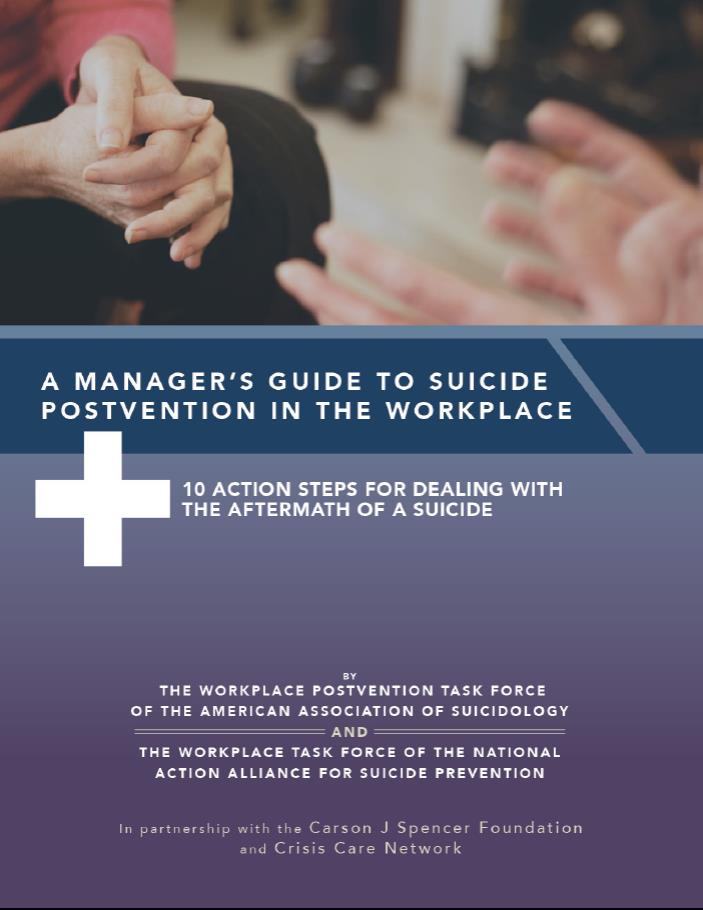
In the U.S., the majority of people who take their lives are working-aged people, and yet workplaces are often unprepared to deal with this crisis. Today the American Association of Suicidology (AAS) and the National Action Alliance for Suicide Prevention (Action Alliance) announce the launch of a collaborative publication, in partnership with Crisis Care Network (CCN), and the Carson J Spencer Foundation entitled A Manager’s Guide to Suicide Postvention in the Workplace: 10 Action Steps for Dealing with the Aftermath of Suicide.

For every suicide death, an estimated minimum of six people are affected, resulting in approximately six million American “survivors of suicide” in the last 25 years. The creation of the guide came as a logical step for the collaborators. “The demographics of suicide inform us that the working-age individual, in particular working-age male, is most at risk for suicide,” explained Dr. Alan Berman, Executive Director for the AAS. “A sizeable proportion of these deaths by suicide occur on the worksite, or otherwise affect the worksite, pointing to an increased need for postvention in the working population. These guidelines are most important for systems of employment, in the worst case possibility that such a tragedy occurs.”

Manager's Guide Cover
The guide provides clear steps for postvention, giving leadership a sense of how to immediately respond to the traumatic event, have a plan in the short-term for recovery, and consider long-term strategies for helping employees cope down the line. Dr. Sally Spencer-Thomas, CEO & Co-Founder of the Carson J Spencer Foundation, explained: “We collaborated to create succinct procedures with checklists and flow charts to be a go-to guide for people dealing with the crisis of suicide. Our goal is to help to reduce the impact of the suicide event by offering a blueprint to handling these challenging situations. The guidebook allows for immediate access to clear steps to take for moving forward, and helps workplaces plan to move from a solely reactive position on these issues into policy development and trainings.”

“In many postvention responses we saw business leaders forced to operate well outside of their training and expertise, grappling with unanswered and unanswerable questions,” said Bob VandePol, President of CCN. “When there is a death by suicide, all eyes turn to leadership and people take their cues based upon how leadership responds. It’s also true that people under the influence of traumatic stress look to leadership and make assumptions about their own personal worth within the company, so there is tremendous power in a calm, compassionate presence by management during this time.”

The collaborators worked to create a set of guidelines that are useful across varied types of workplaces, and they expect a range of individuals within these organizations and companies to find the information immediately helpful .“This guide can be useful to managers at all levels–from the CEO of a large business to a front-line supervisor of a small organization,” asserted Action Alliance Executive Secretary, Dr. David Litts. The Action Alliance played a key role in bringing these groups together to develop this resource.

To download your own copy of these guidelines and to review others, please go to http://carsonjspencer.org/ManagersGuidebook.pdf.

American Association of Suicidology
Founded in 1968, AAS is a membership organization for all those involved in suicide prevention and intervention, or touched by suicide. AAS leads the advancement of scientific and programmatic efforts in suicide prevention through research, education and training, the development of standards and resources, and survivor support services.
Contact: Alan L. Berman, PhD, ABPP, Executive Director, 202-237-2280, berman@suicidology.org

National Action Alliance for Suicide Prevention
The National Action Alliance for Suicide Prevention, a public-private coalition, works to advance the National Strategy for Suicide Prevention by championing suicide prevention as a national priority, catalyzing efforts to implement high priority objectives of the National Strategy, and cultivating the resources needed to sustain progress. Launched in 2010 by Health and Human Services Secretary Kathleen Sebelius and former Defense Secretary Robert Gates, the Action Alliance envisions a nation free from the tragic event of suicide. For more information, see www.actionallianceforsuicideprevention.org.
Contact: Katie Deal, Deputy Secretary, 202-572-3722, kdeal@edc.org

The Carson J Spencer Foundation (www.CarsonJSpencer.org) is a Colorado nonprofit, established in 2005. We envision a world where leaders and communities are committed to sustaining a passion for living. We sustain a passion for living by
·         Delivering innovative and effective suicide prevention programs for working-aged   people.
·         Coaching young leaders to develop social enterprises for mental health promotion and suicide prevention.
·         Supporting people bereaved by suicide.
Contact: Sally Spencer-Thomas, PsyD, CEO & Co-Founder, 720-244-6535, sally@carsonjspencer.org

Crisis Care Network
Founded in 1997, Crisis Care Network (CCN) is the EAP industry’s premier provider of Critical Incident Response for the workplace. CCN helps individuals and organizations return to work, life, and productivity following critical incidents. We mitigate the human and financial costs of workplace tragedy such as workers' compensation claims, low morale, employee attrition, and litigation. CCN has established the nation's largest network of master’s- and doctoral-level clinicians trained as Critical Incident Response Specialists, responding more than 1,000 times per month to workplace incidents for EAP’s, insurers, and employers in communities throughout the United States and Canada.


Contact: Judy Beahan, MSW, Clinical Manager, 888-736-0911, Judy.Beahan@crisiscare.com

Tuesday, July 2, 2013

On Being Bold in Suicide Prevention: Innovative Approaches in Innovative Places

Windows by Nina Matthews Photography
   By: Dr. Sally Spencer-Thomas  
     
     I had been in the field of mental health 16 years before my brother Carson took his life in 2004, and I would say that since then I have learned much about the “gaps” that need to be filled in the field of suicide prevention. In the aftermath of his death, our family and his friends came together in our grief,  as many people do, with a strong sense to “do something” and formed the Carson J Spencer Foundation (CJSF).                
     From CJSF’s inception, what quickly became obvious was the huge “gap” between the target population of most suicide prevention efforts and population that most represented by those who were dying.. We were shocked to learn that most people who took their lives were just like Carson: white, working-aged men. We made the commitment to be bold and try to fill this “gap” with innovative approaches in innovative places.
     Innovation is critical in the field of Suicidology because it helps us engage untapped resources, explore new partnerships and ultimately expand our capacity. Without innovation, we will just keep repackaging the same methods and will be limited in our ability to create the significant change we all envision. Innovation begins with an idea to take a radically different approach – especially if it’s difficult.
     In hindsight, we can usually see the benefits of innovation, but at first they are sometimes considered radical ideas. Where would we be if that first crisis call center had never emerged or if the Air Force had decided like so many others had before, that there was nothing that could be done to prevent suicides? Often because innovation challenges convention of how things get done, initial backlash and doubt ensue.               
     Inevitably, trial and error cycle as the innovative idea evolves. Sustained change comes as the context of discovery moves into the context of justification, and rigorous evaluation helps us better understand the cause and effect cycle of change.
     Since my brother Carson was a gifted entrepreneur and not afraid of risk-taking, the founders of CJSF not only dedicated our mission to preventing what happened to him from happening to others, , but also to celebrating his gifts as a dynamic and bold visionary.  
     When taking an inventory of existing suicide prevention efforts, we noted that very few people were addressing suicide prevention in the workplace, and this gap became ours to fill. In 2007 CJSF launched the Working Minds program (www.WorkingMinds.org) and in 2009 we published the Working Minds Toolkit, which was accepted to the National Best Practice Registry in 2010. The goal of these efforts is to build capacity in workplaces so that they are better able to implement comprehensive and sustained suicide prevention programs.
     Today, with the help of the National Action Alliance for Suicide Prevention’s Workplace Task Force, workplace suicide prevention efforts are better able to leverage the influence of leaders from across the country and create a “tipping point” of change. We are bringing together executives and industry leaders to be spokespeople for the cause; we are pulling together resources to outline a blueprint for change; and we are partnering with the Public Education and Awareness Task Force to “Change the Conversation.”
     The Workplace Task Force in partnership with CJSF and others, has launched three new innovative resources for workplaces:


     In addition, we need innovation to reach those at highest risk for suicide – men of working age with multiple risk factors who are also least likely to seek care. For years, the same message – “if you are depressed, seek help” – was repackaged with little success in reaching this demographic.  What the effort needed was a brand that was compelling to high-risk men. In 2007, the Carson J Spencer Foundation, Cactus Marketing and Colorado’s Office of Suicide Prevention – a public-private-nonprofit partnership – came together to find a new way to reach high-risk men by using “manspeak” and humor.
Hope Lights by Nina Matthews Photography
     On July 9, 2012, after four years of research, development and planning, the partnership launched the one-of-a-kind Man Therapy™ campaign (www.ManTherapy.org) with an article in the New York Times. While the unconventional approach raised a few eyebrows, our initial results look promising so far – the campaign seems to be reaching the target audience and having the intended effect. In just nine short months, the website has experienced over 200,000 unique visitors averaging over 6 minutes per visit. More than 60,000 people have completed the 18-point head inspection (a self-screening tool) and 15,000-plus have accessed information on crisis services. The qualitative feedback we have received from men and therapists alike is that men’s thinking about mental health shifts during their interaction with www.ManTherapy.org  and they are more likely to do something different about their problems as a result.


     While innovation is particularly unnerving in a profession where lives are at stake, we must “be visible, be vocal, be visionary. There is no shame in stepping forward, but there is great risk in holding back and just hoping for the best.” (Higher Education Center)

Wednesday, May 29, 2013

Wellness: A Holistic Approach to Suicide Prevention

Author: Dr. Sally Spencer-Thomas
           Why do people burnout and find themselves spiraling into hopeless despair? Part of the answer lies in upstream preventative maintenance, or “wellness.” In our very busy world, we all need to figure out how to take better care of ourselves. When people hear the term “wellness” they often just think of physical wellness:  sleeping eight hours a night, drinking 64 ounces of water a day, working out for at least ½ hour three times a week, eating five fruits and vegetables a day, etc.  Physical wellness is important, but it is only one dimension of overall wellness. Mental, social and emotional, and spiritual aspects of wellness are also key and highly related to each other.
I remember my first run after the death of my brother. I had been running as my main form of exercise for almost 8 years before he died. I found that running was the sport for me – someone who valued exercise but didn’t bring many athletic gifts to the table. I started doing marathons in 2002, and found myself hooked. I was training for the Little Rock Marathon in Arkansas when Carson’s suicide literally knocked me off my feet. I was barely able to get out of bed and function each day, let alone train. But somehow, one day I put on my running shoes and headed out the door. Thoughout the whole run, I had tears on my face. For the next 10 weeks, running became my therapy. My time alone, away from all the trauma; my time to grieve and to think. I ran the marathon and dedicated each mile to a memory of our lives together. Today, I continue to run almost daily, and find it is a critical part of my mental health practice.
A large body of research shows a positive association between physical activity and psychological well-being.[1] New research is supporting a connection between exercise and suicide prevention. Even after adjusting for confounding variables such as demographics, depression, alcoholism, and more, the risk for nearly lethal suicide attempts was five times greater among those who had not been physically active in the past month than for those who were.[2] Another study compared athletic and nonathletic adolescents and found that the most athletic felt depressed less often and were much less likely to report suicidal thoughts or attempts.[3] A more recent study found that aerobic activity provided a distinct protection against suicide by reducing the risk of hopelessness and depression. There was one exception to this finding: women who combined frequent physical activity with deleterious dieting behavior had a greater risk for suicidal behavior.[4] So yes, physical wellness is a very important contributor to overall health, but there is much more to wellness than this.
Mental wellness is about always sharpening our skills and committing to lifelong learning.  Mental wellness comes from a sense of inner responsibility to always finding ways to improve – increasing knowledge, asking critical questions, trying new things, advancing skill sets, and so on. Social and emotional wellness is about keeping our relationships and our emotional well-being intact. It’s about conflict resolution, self-esteem, and coping skills. Finally, spiritual wellness is about committing to something larger than us – whether that is participating in our faith community, volunteering to serve the common good, standing up for injustice, or appreciating nature.
As with any preventative maintenance process, each wellness component needs attention over the long term so that we can sustain high performance over time. Unfortunately, when we are in crisis mode, these wellness practices are often the first to go. We cut out sleep, skip our weekly faith services, and drop out of therapy because we are just too overwhelmed with our lives. And just like when we neglect to change the oil and rotate the tires on our car, these decisions come back to haunt us.  
In order to self-assess your commitment to wellness, track the amount of time and money you spend in crisis mode – cramming for exams, dealing with drama in their relationships, tending to illnesses and injuries, and so on – and how much time and money you spend in true wellness practices (escape behaviors like hours of video games and excessive drinking do not count). When you do this, you often quickly realize that one of the reasons you constantly feel in a state of distress is because you are neglecting yourself.
Research tells us that pro-healthy-lifestyle attitudes matter greatly.[5] Those who see health as a value and have an optimistic perspective have built-in buffers against psychological distress. Optimism was actually the best predictor of both psychological well-being and decreased levels of distress. The researchers explained that this positive outlook helped students persevere during difficult times. “Health as a value” was seen in students who are likely to refrain from health-compromising behaviors like substance abuse and who are more like to engage in health-promoting behaviors like working out. This stable, enduring characteristic was linked to psychological well-being.
In closing, sometimes all you need to get through the bumps in life is a little reminder of an Irish proverb,A good laugh and a long sleep are the best cures in the doctor's book.”


[1] Taliaferro, Lindsay, Rienzo, Barbara, Pigg, Morgan, Miller, M. David, and Dodd, Virginia (2008). Associations between physical activity and reduced rates of hopelessness, depression and suicidal behavior among college students. Journal of American College Health, 57, 427-435.
[2] Simon, T., Powell, K. & Swann, A. Involvement in physical activity and risk for nearly lethal suicide attempts. American Journal of Preventive Medicine, 27(4), 310-315.
[3] Ferron, C., Narring, F., Cauderay, M., & Michaud, P (1999). Sport activity in adolescence: Associations with health perceptions and experimental behaviours. Health Education Research, 14(2), 225-233.
[4] Taliaferro, Lindsay, Rienzo, Barbara, Pigg, Morgan, Miller, M. David, and Dodd, Virginia (2008). Associations between physical activity and reduced rates of hopelessness, depression and suicidal behavior among college students. Journal of American College Health, 57, 427-435.
[5] Burris, Jessica, Brechting, Emily, Salsman, John, Carlson, Charles (2009). Factors associated with psychological well-being and distress of university students. Journal of American College Health, 57(5), 536-542.

Friday, May 17, 2013

Suicide Prevention – Everyone has a Role


     Jerry Reed, Director the National Suicide Prevention Resource Center presented the keynote, “The 2012 National Strategy for Suicide Prevention: We all have a role” at today’s Bridging the Divide Suicide Awareness and Prevention Summit in Denver, Colorado.

     Dr. Reed started the day with this quote, “You all have a piece of the suicide prevention puzzle – it’s important to all do our part to advance the cause.”

     Throughout the presentation he helped to connect the many roles that are needed to eliminate the tragedy of suicide. He shared three pillars in a “Model for Action” [Richmond and Kotelchuch’s Health Policy Model, 1997] to frame with broad brushes the work that is needed to create a tipping point of change:

1)     Knowledge base – we need to build an evidence-base to know what works for change and a research agenda to help guide our scientific endeavors
2)     Political Will – we need to generate momentum and energy among our community leaders and influencers
3)     Social Strategy – we need to have a coordinated blueprint for change, to help ensure that all players are working together to agreed-upon outcomes

     Reed shared the history of the suicide prevention movement and how the efforts of a few key survivors of suicide loss translated into some sweeping national changes over the last 15 years, eventually evolving into in the 2010 launch of National Action Alliance of Suicide Prevention .
He shared the launch video, documenting the event that brought together some of our nation’s most influential leaders to draw attention to this ground-breaking public-private partnership designed to advance the National Strategy for Suicide Prevention . Some of the voices in the video include:
  • ·       Secretary of Army, “Suicide violates our basic warrior ethos. You never leave a comrade behind.”
    ·       Eduardo Vega, Co-Chair of Suicide Attempt Survivors Task Force: “By holding out the hope for others, we let them know we need them. We need to preserve our greatest asset in our county – our brothers and sisters.”
    ·       Senator Gordon Smith: “Those who do this work, work on the side of angels.” 

     People often ask, “what role can I play?” From researchers, to mental health professionals, to suicide survivors, to the media, to every day citizens, everyone can play a role in the work. Details the individual and systemic contributions are outlined in the National Strategy.

     As a way to help us all remember that many of us carry puzzle pieces in this national effort, Reed quoted the National Strategy for Suicide Prevention dedication:
To those who have lost their lives by suicide,
To those who struggle with thoughts of suicide,
To those who have made an attempt on their lives,
To those caring for someone who struggles,
To those left behind after a death by suicide
To those in recover and
To all those who work tirelessly to prevent suicide and suicide attempts in our nation,
We believe that we can and we will make a difference.


Monday, April 29, 2013

Marathoning is about Resilience: “A Tough Blow – A Tougher Town” – Tougher Sport


By: Dr. Sally Spencer-Thomas

As an avid marathoner and a former Bostonian, I found myself like so many around the world crushed by the news of the devastating events of the Boston Marathon bombing this week. I spent countless hours going through news websites and listening to NPR trying to get my mind to comprehend what happened.
Although I am thousands of miles away, I can see it. I will never be able to achieve a qualifying time for this premiere race, but I can imagine what it might have felt like to be a 4:09 finisher. To see the finish line and anticipate the cheers and hugs from family and friends – all you can think about is crossing that threshold. I have an eight-year-old boy, the same age as Martin Richard, one of three people killed in the blasts. I can imagine looking for him and my other sons and husband in the crowd. I can feel the confusion of the thousands of runners who were told to stop in the middle of a race that many of them had probably prepared for over months or years. I can remember the celebration of a city and state so proud of this iconic event they actually take a holiday so everyone can take part.
As the events unfolded, I read an outpouring of tweets from the international marathon community, stunned and disturbed by the news, as the images of the worlds’ flags blowing from the blast were seared into our consciousness.
The next morning I poured through the Boston Globe, I was reminded about the special bond between runner and spectator. Very few other sports let spectators touch or feed the athletes during the competition. Spectators, with their cow bells and goofy signs, often provide the energy that lifts the runner through the difficult parts of the race. And yet, at this tragedy, it was the spectators that suffered the most damage.
So tragic, so senseless all of this. And yet, “in the night of death, hope sees a star and listening love can hear the rustle of a wing” (Robert Ingersall). What we all saw and read that day and since gives me great hope about our humanity:
·         the first responders and medical teams who signed up for the event thinking they would be handling traffic, dehydration and blisters who then found themselves in the middle of a war zone and just did what needed to be done
·         the residents who took so many stranded runners into their homes and gave them comfort and a way to connect with their families
·         the runners themselves, some of whom gave blood after running an exhausting race
·         the Bostonians who refused to let this stop their city. As Scot Lehigh of the Boston Globe stated in his editorial, “…We won’t be paralyzed by fear. We’ll take reasonable precautions, yes. But we won’t take cover. And we won’t cower. This, after all, is Boston.”
The Boston Marathon will continue to be the iconic event for runners and spectators everywhere. Boston will continue to pull together, recover and thrive. It may have been a tough blow, but as Lehigh said, “it’s a tougher town” with a tougher sport that won’t be brought down.

Thursday, April 18, 2013

Creating Resilient Communities

Republished with permission from CJSF Guest Blogger Jess Stohlmann


Resilience is the ability to succeed and prosper even after facing challenges, setbacks, and hardships. It is supported by a set of skills that can be developed. In the fields of character education, psychology, etc., we look at individuals’ capacity to be resilient. While the Carson J Spencer Foundation celebrates its core value of resilience this month, I would like to shift the scope to start considering what it means to build resilient communities.
Resilience is contagious and has the power to transform communities, as well as the lived experiences of their members. Community resiliency is deeply rooted in community trust, connectedness, respect and cooperation, which in turn help communities thrive. For a community to be resilient, it needs to do three big things: prepare for crisis, plan for the best, and mobilize social capital.
Preparing for crisis means that a community looks at risk factors and builds the capacity to prevent crises and intervene when they occur. This would include things like having the budget and infrastructure to respond to community needs, and finding highly qualified people to deliver prevention and intervention services. This capacity should be created with the help of all relevant for profit, for impact, and government agencies. Getting everyone involved in prevention and intervention creates a system of checks and balances, and ensures that when hard times come (as we know they will) there is a web of support in place.
Planning for the best is my way of saying, “Be optimistic.” Opportunities are missed every day because communities aren’t looking for them or aren’t prepared for them. Taking an optimistic approach and being open to innovations and opportunities that could have a positive impact on the well-being of a community and its members allows for amazing, unexpected happenings to occur. Planning for the best means taking calculated risks, and trusting that we are prepared to handle the outcomes. Growth and progress are instigated by the process of planning for the best. When we evaluate and take risks, we open the doors to a bigger, brighter future than we could have imagined before. Creating a culture of planning for the best ensures new successes and opportunities for the community.
Mobilizing social capital is the practice of identifying the successful organizations and approaches to work and lifestyle, and finding ways to grow them and replicate their success. Finding ways to expand the positive attributes of our community only builds greater networks of support and opportunities for growth and success.
These three strategies for building resilient communities poise us for success and prosperity even in times of hardship. Creating a connected, synchronized plan to build resilience allows communities to respond to the needs of each individual and group, and to be successful together.