By Guest Blogger: Franklin Cook
A recent survey of men bereaved by suicide suggests that:
• Suicide bereavement is profound and sustained for men, with 30% reporting that grief remained a constant difficulty in their lives one to three years after their loss and another 30% saying that it was a constant difficulty for longer than three years.
• Men believe friends, family, and peers (others who have experienced a loss to suicide) are the most helpful.
• Peer assistance and one-on-one help are especially valued by men, who also say they rely on information from the Internet for assistance.
• Most men believe men and women grief differently, and plenty of men fit the stereotypes commonly associated with men's handling of emotional matters.
• Many men, on the other hand, believe that stereotypes get in the way of healthy grieving and that societal influences hamper men's grieving.
• Many also see bereavement as very individualistic, reporting that they are as emotionally expressive about their grief as women are.
• Men are interested in being peer helpers for other bereaved men, especially if they are far enough along in their own grief and are trained and supported.
This last finding -- that many men are willing to help each other with grief after suicide -- is of utmost importance, for men themselves likely hold the keys to their own recovery.
Unified Community Solutions (my private consultancy) and the Carson J Spencer Foundation (Sally Spencer-Thomas's nonprofit organization) distributed the survey to help us explore developing more-effective programs and resources for suicide bereaved men. We are hopeful that by this summer, we'll have an idea about how we might begin making new inroads into supporting men bereaved by suicide.
Please see the copy of the slides from the presentation on the survey that Sally and I (and Rick Mogil, who directs suicide grief programs for the Didi Hirsch Community Mental Health Center) delivered at the American Association of Suicidology conference in Los Angeles last Saturday.
Monday, April 21, 2014


Thursday, March 27, 2014
A Historic Moment in Suicide Prevention: Summit on Lived Experience
Reposted with permission from the American Association of Suicidology
 On March 6, 2014, a historic moment occurred in San Francisco. The first ever National Summit on Lived Experience in Suicide Prevention convened – suicide attempts survivors, suicide loss survivors and people representing mental health service systems came together to explore how we can “light the way forward.”
The meeting was hosted by the Mental Health Association of San Francisco with support from the Substance Abuse and Mental Health Services Administration (SAMHSA), the National Action Alliance for Suicide Prevention (“Action Alliance”) and the National Suicide Prevention Lifeline (NSPL). The goal of the meeting was to open up an open and honest conversation about how best to move the goals of the Action Alliance’s Suicide Attempt Survivors Task Force and Zero Suicide Initiative forward with coordination and compassion.
The meeting began with Dr. DeQuincy Lezine sharing an overview of the Suicide Attempt Survivors Task Force soon-to-be released guide for how the suicide prevention field can best incorporate the “lived expertise” of those who have survived their own suicide attempts.
The guide underscores the importance of real-world wisdom that people gain through surviving and can share with others to guide best practices in research, treatment and prevention efforts. A main message of the document is to include attempt survivors in all areas of suicide prevention – as leaders and in critical masses. In addition to covering key policy, practice and program suggestions, Dr. Lezine described the core values of the task force:
- Inspire Hope, find meaning and purpose
- Preserve dignity, counter stigma, stereotypes discrimination
- Connect people to peer supports
- Promote community connectedness
- Engage and support family and friends
- Respect and support cultural spiritual beliefs and traditions
- Promote choice and collaboration
- Provide timely access to care and support
Next David Covington from the Zero Suicide Initiative shared the concept and practices of this high priority focus of the Action Alliance. The Zero Suicide Initiative is a “commitment to suicide prevention in health and behavioral healthcare systems aligned with a specific set of tools and strategies. It advocates for a systematic approach to improve outcomes and fill gaps to relentlessly pursue a reduction in suicide death and calls for visible, vocal and visionary leadership. Additionally, the initiative strives to develop of a competent, confident and caring workforce within behavioral health.
 “We believe that suicide is preventable always, up to the last minute,” said Covington. “Let’s create a suicide deterrent system.”
Most of the conversation over the course of the day centered on how these two groups could reduce the fear each has about the other. Suicide attempt survivors expressed fear about being misunderstood, stigmatized, and punished in many forms when trying to access professional care. Mental health providers have fear about not knowing what to do, about getting sued, and about having someone “die on my watch.”
The dialogue continued through the morning and encouraged both groups to look forward and find ways to improve collaboration and understanding. Here are some moving sound bites:
· “People need to know they can disclose suicidal thoughts and that they will get help, not get punished,” Shari Sinwelski, National Suicide Prevention Lifeline
· “Every attempt survivor should define the support network for himself or herself.”
· “Emergency care providers need to improve practices to preserve dignity of people in the middle of a suicide crisis.”
· “Most clinical care work is focused on assessment of risk; we need to shift this focus to collaborative care,” David Covington
· “The problem is clinicians don’t feel safe and they don’t know what to do,” Shari Sinwelski
· “To start with a place of assessment creates disconnection,” Leah Harris, National Empowerment Center
· “Stop assessing the symptoms. When we do that we are working from a deficit model rather than a strength model. Rather than creating a treatment plan create a hope plan and assess for that. Find out what brings meaning and purpose and create a plan for that,” Tom Kelly, Magellan Health Services of Arizona

· Tom Kelly, “I haven't had a suicide attempt since 2001. Since then I became an advocate, and I developed meaning and purpose.”
· “How do we fill the middle gap in services when people are not feeling home provides enough support but don’t need inpatient care? Peer support can fill this gap. Right now the system is insufficient – we just evaluate, medicate, vacate,” CW Tillman, Consumer Advocate
· “Let’s build a strengths-based approach – rather than ‘what’s wrong with you’ shift to ‘what happened to you.’ Let’s provide trauma informed care. Change some primary assumptions,” Leah Harris.
· “The concept of Zero Suicide is really transformative. I like the fact that people react so strongly to it,” Eduardo Vega, Mental Health Association of San Francisco. “We can take the outlandish out of the picture by saying our goal is that no one in this building kill themselves today. Then we can expand to ‘can we work to stop suicide in this town this week?’”
· “The field has talked too much about the difference between suicide attempt survivors and those who die by suicide. The intrapsychic experience is the same,” Covington
· “Over the decades, individual mental health clinicians have made heroic efforts to save lives but systems of care have done very little,” Richard McKeon, SAMHSA.
 · “People who go through training for suicide prevention get increased confidence and change culture within a system. People become less afraid and are more likely to reach out,” Becky Stoll, Centerstone
· “Suicide prevention has not been informed by peers who have experienced the agony and decision making. They can provide support that can be magic,” Eduardo Vega.
· “Suicide attempt survivors should not just be a token presence in the conversation of how to prevent suicide. If have 25% each of researchers, care providers, loved ones at the table, we also need 25% attempt survivors. Critical mass offers meaningful input. Like 32 degrees. Below water freezes, above water is just cold,” David Covington
· “How do we infuse recovery oriented perspectives – a spirit of optimism – in systems of care?” Leah Harris. “How do we focus on what’s strong rather than what’s wrong?”
· How do we reframe safety from something that is more about the clinician’s need for assurance to something that’s more about connectedness, hope and meaning?
The meeting concluded with a brainstorming session on key messages to promote the goals of these two groups and how we might best invigorate the field around these goals. The following list of ideas emerged:
· Establish partnerships and communities of support
· Move beyond fear to optimism
· Introduce behavioral health professionals to people’s stories of hope and recovery and show the value, “your experience can help me help other people”
· How do value peers in suicide prevention work? We can pay them well and identify them as leaders/professionals
· Let’s move behavioral health systems from precontemplation to contemplation and get them to think about, “Maybe the system doesn’t work”
· Attempting suicide didn’t destroy my life; it transformed it.
· Sometimes when things make you angry you pay attention. Language matters.
 · Crisis is an opportunity. If in the middle of a transformative moment you are punished, it stops the process in its tracks.
· Coercion is system failure.
· People don’t send you flowers and cards when you are in the hospital for a psychiatric condition.
· “Continuity of care is really about not giving up on someone,” John Draper, National Suicide Prevention Lifeline
· “When we create system change, don’t bolt it on, bake it in. Change will only last as long as there is energy around something. When it is bolted on it won’t stick; baked in means here to stay,” David Covington
· Board members and other leaders for behavioral health organizations can act as secret shoppers by visiting behavioral health care as undercover bosses. This experience can be eye opening.
· Ask suicide attempt survivors, “How can we celebrate your survival?”
· “I am not a lost cause. I am a person.”
The meeting closed with a round robin discussion of what people were taking away from the Summit. Many tears were shed as people disclosed the momentous opportunity created by the shared understanding that commenced on that day.
To view the twitter feed from the day, please visit: http://storify.com/sspencerthomas/national-summit-on-lived-experience-in-suicide-pre
To view the video on Tools for Change please click this link here: Mental Health Advocacy conference in San Francisco, March 7 & 8. Hosted by Mental Health Association of San Francisco.
To view the video on Tools for Change please click this link here: Mental Health Advocacy conference in San Francisco, March 7 & 8. Hosted by Mental Health Association of San Francisco.
Winners Announced in Student Entrepreneur Business Plan Competition
The Carson J Spencer
Foundation Funds Youth Social Enterprises to Prevent Suicide
 |
| Judges for Returning Businesses Photo: Carly Goldsmith |
The returning business competition took place in the board
room of Holland & Hart, LLC. Of the returning businesses, the three
finalists were Green Mountain High School, Columbine High School and Thomas
Jefferson High School. Green Mountain came in 2nd place with an
award of $250 for their business idea to create a book called, “Dear Parents
from Teens: Top 10 Things We Want You to Know to Help Us Get through Our
Adolescence.” Columbine High School took 1st place winning an award
of $500 to continue to fund their multi-dimensional business that uses
technology and branded lanyards to encourage students to build resilience and
reach out to one another during times of struggle.
The new business competition, which took place at Mountain
States Employers Council, showcased finalists from Gateway High School,
Highlands Ranch High School, and Eagle Ridge Academy. All participating schools
had innovative approaches to suicide prevention in their communities but Eagle
Ridge Academy took 2nd place with an award of $250 of seed funding
and Gateway High School was awarded 1st place and $500 for their
business of branded cell phone cases that help students build compassionate
communication skills.
###
 |
| Gateway High School 1st Place Winners New Business Competition Photo: Michael Snively |
 |
| Eagle Ridge Academy 2nd Place Winners New Business Competition Photo: Michael Snively |
 |
| Green Mountain High School Returning Business Competition Photo: Carly Goldsmith |
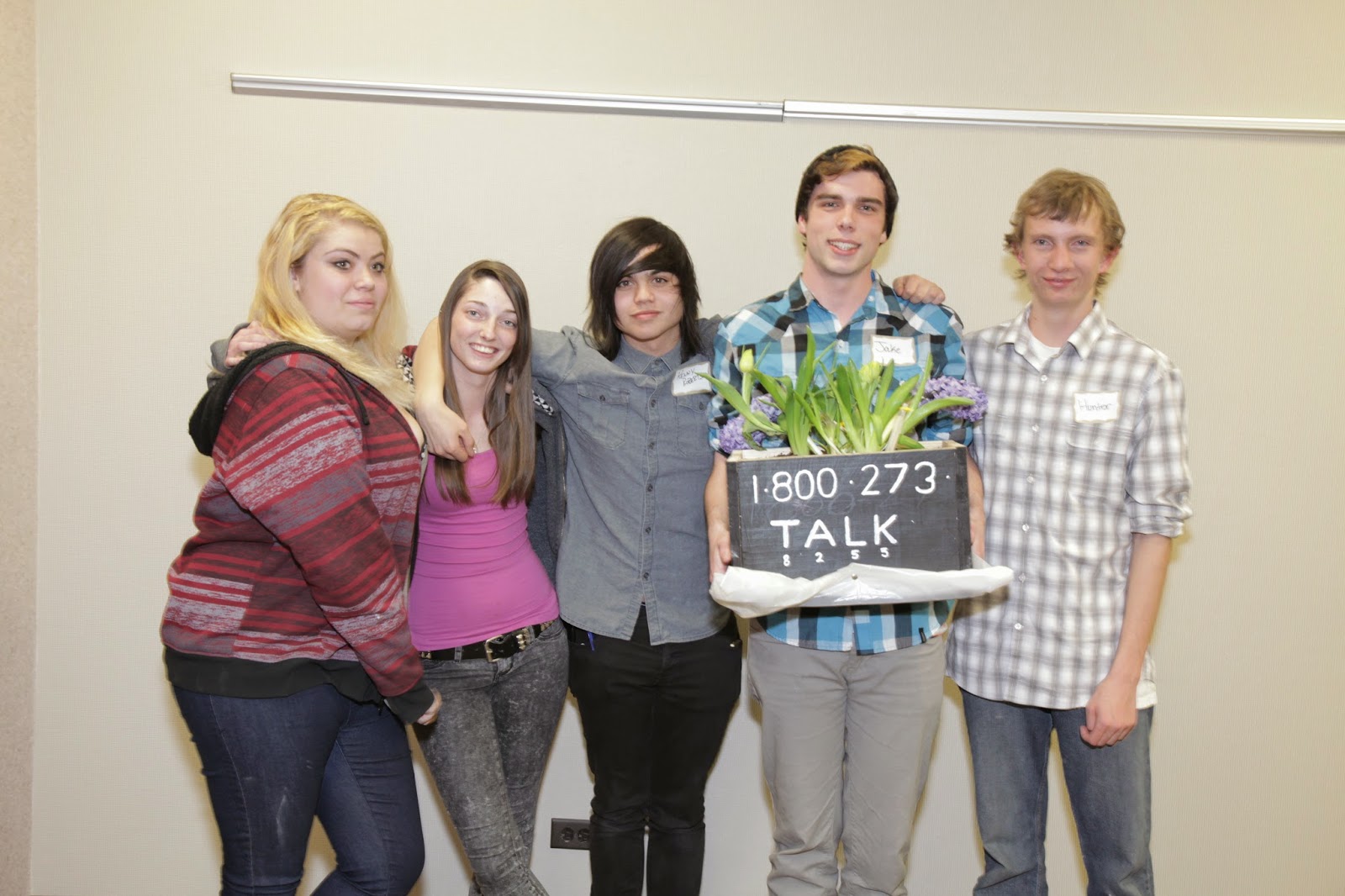 |
| Highlands Ranch High School New Business Competition Finalists Photo: Michael Snively |
 |
| Columbine High School First Place Winners Returning Business Competition Photo: Carly Goldsmith |
 |
| Thomas Jefferson High School Returning Business Plan Finalists Photo: Carly Goldsmith |
The Carson J Spencer Foundation (www.CarsonJSpencer.org) is a Colorado nonprofit, established in 2005. We envision a world where leaders and
communities are committed to sustaining a passion for living. We sustain a passion for living by:
- Delivering
innovative and effective suicide prevention programs for working-aged
people
- Empowering
youth entrepreneurs to prevent suicide
- Supporting
people bereaved by suicide
The Carson J Spencer Foundation is the proud 2013 recipient of the
“Small Nonprofit of the Year” award from the Denver Metro Chamber of Commerce.
YOUTH IMPACT ENTREPRENEURSHIP PROGRAM IGNITES THE FIRE WITHIN
Colorado-Based
Entrepreneurial Suicide Prevention Initiative Launches National Expansion
 Denver, Colorado. March 28, 2014. While the majority of suicide deaths occur in
working aged adults, the journey often begins in youth with suicidal thoughts
and suicidal behavior. When a teen dies by or attempts, the impact is devastating
and long-standing, and the ripple effects on family, friends, schools and
communities profound. For these reasons, the
Denver, Colorado. March 28, 2014. While the majority of suicide deaths occur in
working aged adults, the journey often begins in youth with suicidal thoughts
and suicidal behavior. When a teen dies by or attempts, the impact is devastating
and long-standing, and the ripple effects on family, friends, schools and
communities profound. For these reasons, the
Carson J Spencer Foundation takes
an “upstream” approach to this challenging public health issue with its FIRE
Within program. The FIRE Within program, a partnership among the Carson J
Spencer Foundation, the Second Wind Fund and Junior Achievement, is a teen
leadership initiative that engages high school students to use entrepreneurial
strategies to alleviate root causes to student distress. In other words,
students create an innovative business that raises both money and awareness for
suicide prevention and mental health promotion. With a significant investment
from the Adolph Coors Foundation, the program expanded from three to 50 schools
in Colorado from 2011-2014. In 2012, the Carson J Spencer Foundation received
additional funding from the Manhattan-based Ittleson Foundation to scale the
program nationally. During 2013, the Carson J Spencer Foundation hosted
multiple Executive Roundtable sessions around the country to gauge community
interest in the program and narrowed down the pool of possible locations to
eight sites. After a six-month feasibility study, the Carson J Spencer
Foundation announces today that the pilot effort for the national expansion
will include testing the program’s viability in New York City, San Francisco, and
Massachusetts starting September 2014.
For
more information on the FIRE Within visit: http://carsonjspencer.org/programs/firewithin/
 To
achieve this pilot effort, the Carson J Spencer Foundation is collaborating
with the Mental Health Association of New York City (MHA-NYC), the Mental
Health Association of San Francisco (MHASF), Riverside Trauma Center
(Massachusetts), and the Cape and Islands Youth Suicide Prevention Project
(Massachusetts). Each of these “hub partners” will implement the FIRE Within
program in three or more schools when the school year begins next fall.
To
achieve this pilot effort, the Carson J Spencer Foundation is collaborating
with the Mental Health Association of New York City (MHA-NYC), the Mental
Health Association of San Francisco (MHASF), Riverside Trauma Center
(Massachusetts), and the Cape and Islands Youth Suicide Prevention Project
(Massachusetts). Each of these “hub partners” will implement the FIRE Within
program in three or more schools when the school year begins next fall.
“MHA-NYC
is proud to be a part of the national launch of the FIRE Within program, an
innovative and effective social entrepreneurship approach to educating and
supporting young people to address suicide prevention in their communities,”
said Lisa Furst, Director of Public Education, MHA-NYC.
“The
Mental Health Association of San Francisco is thrilled to be partnering with
the Carson J Spencer Foundation on the first implementation of FIRE Within in
California,” said Eduardo Vega, Executive Director of MHASF. “Diverse
metropolitan communities like ours that are challenged by youth suicide need
solutions that actively engage youth and empower them by putting them in the
driver's seat to make an impact on their peers. The unique entrepreneurial
approach of the FIRE Within develops leadership and creativity while it engages
young people to support each other, to work as change agents in nontraditional
ways, and to challenge stigma associated with mental health conditions.”
Over
the full academic year, the FIRE Within program gives students the opportunity
to understand firsthand how business can positively impact a community. They
learn about innovation and business skills, they build capacity for suicide
prevention and mental health promotion, they use needs assessment tools to
uncover the root causes of student suffering, and then they put it all together
and launch a business that generates profit while alleviating the drivers of
distress.
 “Riverside
Trauma Center is extremely excited about collaborating with the Carson J
Spencer Foundation on the FIRE Within program,” says Larry Berkowitz, Director
of the Riverside Trauma Center. “This ‘outside the box’ approach to youth suicide
prevention builds leadership skills, connects local businesses with the young
people in their communities, and promotes recovery. This creative program will
support Riverside’s efforts to reduce the impact of suicide and suicidal
behaviors among youth in Massachusetts.”
“Riverside
Trauma Center is extremely excited about collaborating with the Carson J
Spencer Foundation on the FIRE Within program,” says Larry Berkowitz, Director
of the Riverside Trauma Center. “This ‘outside the box’ approach to youth suicide
prevention builds leadership skills, connects local businesses with the young
people in their communities, and promotes recovery. This creative program will
support Riverside’s efforts to reduce the impact of suicide and suicidal
behaviors among youth in Massachusetts.”
Maura
Weir, Coordinator for the Cape and Islands Youth Suicide Prevention Project of
the Community Health Center of Cape Cod adds, “The decision to partner with the
Carson J Spencer Foundation was made because of their great leadership and
because the FIRE Within is a dynamic program created for young people to get
involved with a very worthy cause.
Suicide prevention is everyone’s business and this program will provide
a strategy to do this with high school aged youth.”
For
more information about how your community can get involved with the FIRE Within
contact Sally Spencer-Thomas Sally@CarsonJSpencer.org
or visit www.CarsonJSpencer.org or
###
About the Carson J Spencer Foundation - Sustaining a Passion for Living
The
Carson J Spencer Foundation (www.CarsonJSpencer.org)
is a Colorado nonprofit, established in 2005.
We envision a world where leaders and communities are committed to
sustaining a passion for living. We sustain a passion for living by:
- Delivering innovative and effective suicide
prevention programs for working-aged people
- Coaching young leaders to develop social
enterprises for mental health promotion and suicide prevention
- Supporting people bereaved by suicide
The Carson J Spencer
Foundation is the proud 2013 recipient of the “Small Nonprofit of the Year”
award from the Denver Metro Chamber of Commerce.
Subscribe to:
Posts (Atom)